Deutsche Version

Klimafeld Wissen · Building with hemp

Hemp-lime wall assemblies: 5 construction methods compared

Hemp-lime insulates and fills walls; a separate structure usually carries the loads. Compare five construction methods and their layers.

Explore wall assemblies
AI illustration of a craftswoman plastering a wall in a historic interior
AI-generated illustration of a renovation using hemp-lime.

Five methods at a glance

  1. Cast in place

    Fresh hemp-lime is placed on site around a separately designed structure.

  2. Spray application

    Hemp-lime is applied by machine around a frame or onto a suitable substrate.

  3. Hemp-lime blocks

    Factory-made blocks are laid with compatible mortar.

  4. Prefabricated elements

    Framed elements with hemp-lime infill are prepared in a factory.

  5. Retrofit and heritage

    Supplementary insulation may suit existing buildings after fabric and moisture assessment.

Five construction methods

Expand the layers. Drawings are simplified and not to scale.

1. Cast in place

Fresh hemp-lime is placed around a separately designed structure. Flexible geometry; allow for construction moisture and drying.

Wall layers from inside to outside

Internal plaster · hemp-lime with timber frame · external render or weather protection

2. Spray application

Machine application around a frame or onto a suitable substrate. Useful for larger areas and complex shapes; system and application must be compatible.

Wall layers from inside to outside

Internal finish · sprayed hemp-lime with structure · weather protection

3. Hemp-lime blocks

Factory-made blocks are laid with compatible mortar. A separate structure usually carries building loads.

Wall layers from inside to outside

Internal plaster · hemp-lime blocks with separate structure · facade

4. Prefabricated elements

Framed elements with hemp-lime infill are prepared in a factory. Joint design, transport and assembly require attention.

Wall layers from inside to outside

Internal lining · timber frame with hemp-lime · weather protection

5. Retrofit and heritage

Supplementary insulation or insulating hemp-lime plaster may suit compatible existing walls. Moisture, salts, driving rain and timber joist ends require assessment.

Wall layers from inside to outside

Internal insulation example: internal plaster · hemp-lime · existing masonry · exterior finish

From material to wall assembly

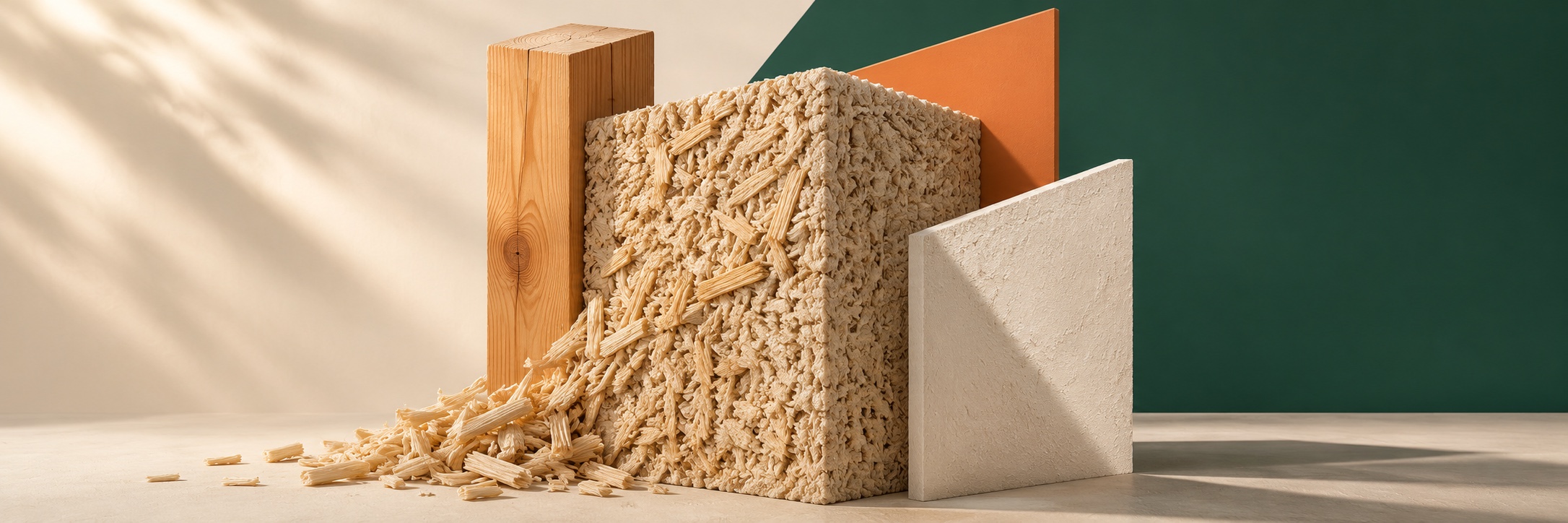
Hemp-lime combines hemp shiv, mineral binder and water. The layer descriptions above show how insulation or infill works with structure and finishes.

AI illustration of hemp shiv, a hemp-lime block and timber
AI-generated illustration of hemp shiv, hemp-lime and timber.

Methods at a glance

MethodTypical strengthDesign focus
Cast in placeIndividual geometryFormwork and moisture
Spray applicationComplex shapesApplication and substrate
BlocksModular workflowJoints and structure
PrefabricationPredictable assemblyPanel junctions and transport
RetrofitAdaptation to existing fabricMoisture and compatibility

Qualitative comparison for orientation, not a ranking or system approval.

Which method interests you?

Bespoke new build

Compare casting and spraying.

Predictable assembly

Compare blocks and prefabrication.

Historic building

Assess existing fabric and moisture before selecting a system.

Understanding building physics

Thermal performance

The U-value depends on the complete assembly, thermal conductivity, thickness and thermal bridges.

Moisture protection

Hemp-lime can buffer moisture but is not waterproof. Plan for plinths, driving rain and drying.

Structure and fire safety

Hemp-lime typically provides insulation or infill. Structural and fire performance require evidence for the particular system.

Carbon footprint

Biogenic carbon is only part of the life-cycle assessment. Binder, transport, construction and end of life also matter.

Educational overview, not a construction specification. Austrian building requirements must be assessed for each project.

Frequently asked questions about hempcrete walls

Is hempcrete load-bearing?

Usually a separately designed structure carries the building loads. Other systems require appropriate evidence.

How thick should a hemp-lime wall be?

It depends on the specific material, thermal bridges and target thermal performance. There is no universal thickness.

Is internal hemp-lime insulation always appropriate for old buildings?

No. Moisture sources, salts, driving rain and junctions need assessment. Heritage requirements may also apply.

Sources and further reading

Steyn, de Villiers & Babafemi (2025): A comprehensive review of hempcrete as a sustainable building material. Review of material composition, construction methods and building physics.

Jellen & Memari (2025): State-of-the-Art Review of Hempcrete for Residential Building Construction. Research overview for residential construction.

Historic England – Internal Wall Insulation (2025) · Guidance on internal insulation and moisture risks.

European Commission – Hemp · Agricultural context.

More about hemp building materials at Klimafeld

Illustration of two Klimafeld heroes with hemp fibres and a material sample
Klimafeld material heroes · AI illustration

Share knowledge. Make a regional difference.

Klimafeld shares knowledge about industrial hemp and works towards regional value chains. Support our nonprofit work.

Become a memberDonate