Fibres
The outer fibres of the stems can be processed into textiles, insulation and composite materials.

Knowledge that helps the future grow
Hemp can connect farming, climate action and construction. What matters is how we grow, process and use it. Explore the potential of industrial hemp – and the questions we need to answer honestly.
Understand hemp →
Klimafeld Association · Knowledge about industrial hemp, building materials and regional resource cycles
This page looks at hemp as an agricultural resource for fibres, shives and seeds. Klimafeld focuses on fibre hemp, regional processing and potential building applications. Our association aims to make knowledge accessible and connect people working in agriculture, processing and construction.
The outer fibres of the stems can be processed into textiles, insulation and composite materials.
The woody inner parts of the stem provide a raw material for hempcrete.
Hemp seeds are used for food and oil, among other applications. The cultivation goal and harvesting method determine which parts of the plant can be used economically.
Climate action in perspective
As hemp grows, it absorbs CO₂ and incorporates carbon into its biomass. What happens to that carbon afterwards depends on how the crop is used. A short-lived product has a different life cycle from a building material that remains in use for many years.
A meaningful carbon assessment also accounts for emissions from cultivation, processing, binders and transport, as well as end of life. Plant uptake alone therefore does not establish permanent emissions savings or a certified carbon offset. [4]
Specific claims need a product-level life cycle assessment with clear system boundaries. Blanket figures per hectare or house cannot replace that evidence.
Understanding hempcrete
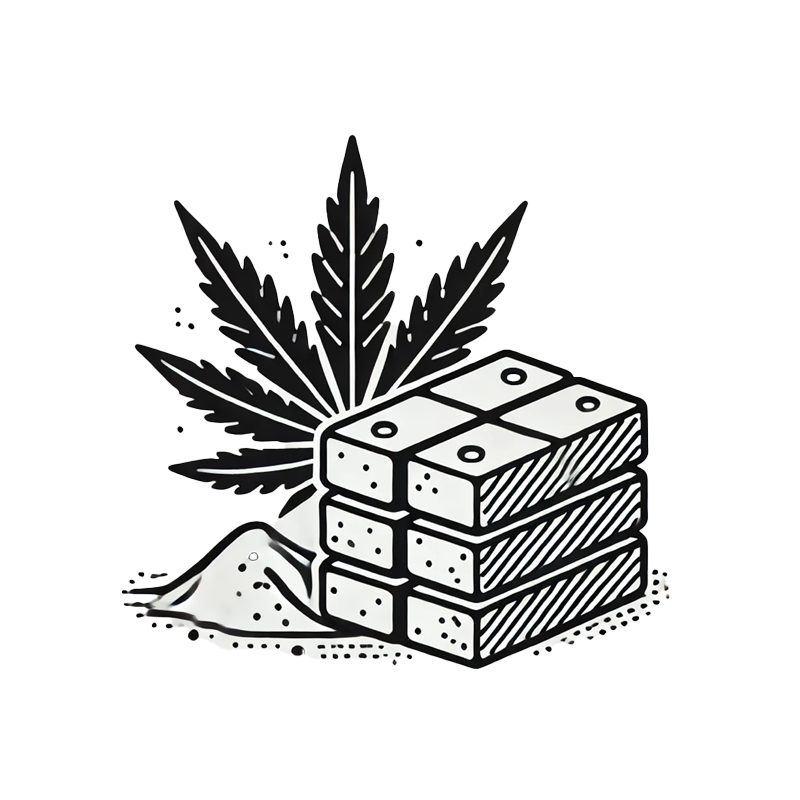
Hempcrete, also called hemp-lime, is made from hemp shives, a mineral binder and water. It can be used as infill or in prefabricated blocks. A separate structural frame typically carries the building loads. Hempcrete is therefore not a direct substitute for load-bearing reinforced concrete. [2]
Hempcrete can provide insulation and absorb and release moisture. Formulation, density and moisture content affect its properties. [3]
Wall build-up, weather protection and drying need to be planned. A specific building project requires verified performance for the product and system being used.
Long service life and suitable reuse are important design goals. Whether materials can be reused or reprocessed also depends on binders and how the building is dismantled.
Starting in the field
Hemp can complement crop rotations. A dense crop shades the soil and can suppress weeds. Its flowers supply pollen, and the crop can provide food and shelter for wildlife. Pesticide requirements are often low, but not always zero. [1]
In practice, location, weather, variety and crop management all matter. Claims such as “always pesticide-free”, “needs hardly any water” or “improves every soil” would go too far. We see hemp as one component of farming adapted to local conditions.


What this means for Klimafeld
Klimafeld carried out a pilot project near Vienna Airport in Schwechat in 2023. We are now planning a regional processing chain in the Vienna and Römerland Carnuntum area. Phase 1 covers decortication and hempcrete; further fibre processing is envisaged for Phase 2.
Industrial implementation is at the planning stage. Our project page explains the current position and the steps still to be resolved.
View the project update →No. Its carbon balance depends on cultivation, processing, materials, use and end of life. A general characteristic of the plant is not evidence for a specific product.
Conventional hempcrete is mainly used as insulation and infill. A separate structure usually carries the loads. The evidence provided for the particular building system is what matters. [2]
There is no single value for all hempcrete products. Research shows that density and moisture content affect thermal conductivity. Building design needs verified product data and the complete construction build-up. [3]
They support Klimafeld’s association activities: sharing knowledge, enabling exchange and developing regional projects. Membership is neither a purchase of building materials nor an investment in a production facility, and it does not include certified carbon offsets.
Edited by Klimafeld Association · Reviewed on 22 October 2026. General material characteristics do not replace product-specific design or assessment.
Help make industrial hemp and regional building ideas easier to understand. Membership supports our association’s work and connects people who want to make a difference.
Support our association →